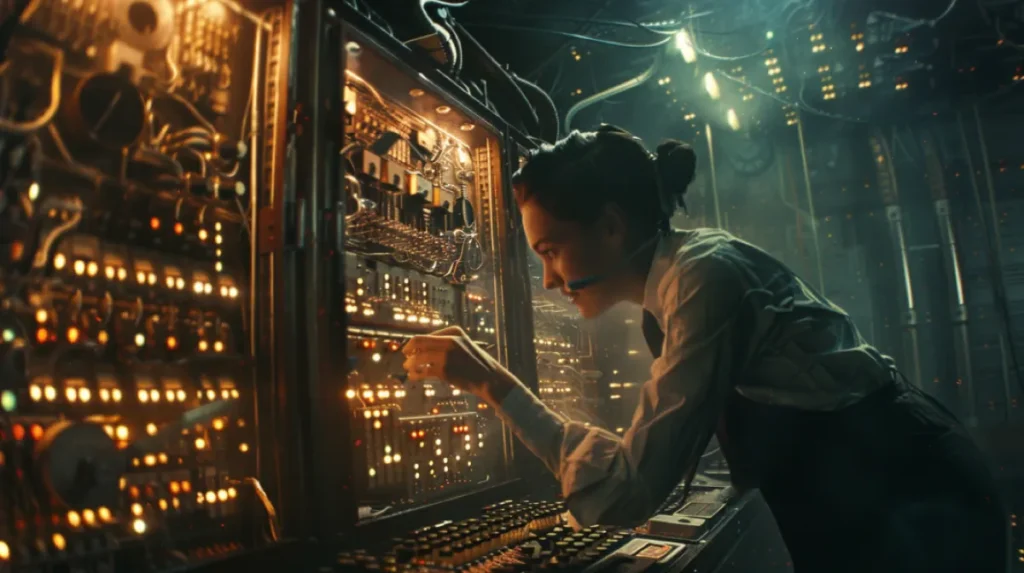
In 1945 you could walk into a room at the University of Pennsylvania and stand in front of ENIAC: 27 tonnes of metal, 17,468 vacuum tubes, and a crew of technicians moving between its panels with boxes of spare valves. When a single tube failed, as it did most days, the machine stopped until someone tracked it down. Even so, it out-calculated every human team in the building.
That room is where the computer you are reading this on really begins. Understand what ENIAC was and you understand where almost everything else comes from: the idea of a program, the split between hardware and software, and the long argument about what a computer is actually for. It also belongs to a bigger story, the history of computing, and it sits at the front of it. Here is the account without the myths.
What was ENIAC?
ENIAC stands for Electronic Numerical Integrator and Computer. It was the first fully electronic, general-purpose digital computer. It could solve different problems without anyone rebuilding the machine, which is exactly what the specialised calculators before it could not do.
Two men designed it, John Presper Eckert and John William Mauchly, at the University of Pennsylvania, with money from the US Army. The original job was narrow: calculate ballistic firing tables for the Second World War. Work began in 1943 and the machine was shown to the public in 1946, once the war was over, as the Computer History Museum records.
One nuance matters here. It was neither the first calculating machine nor the first digital one. What made it a first was the combination: fully electronic, digital and general-purpose, all three in the same machine. Plenty of machines had one or two of those traits. None had all three.
That distinction sounds academic until you use it. A special-purpose machine does one job and then sits idle. A general-purpose machine takes a new set of instructions and becomes a different tool. ENIAC was the first electronic machine to be that flexible, and every computer since has inherited the same trick.
Before ENIAC: it didn’t start from scratch
ENIAC did not appear out of nowhere. The machines before it were already digital, though not fully electronic:
- Z3 (1941), by Konrad Zuse: a programmable digital computer built from electromechanical relays.
- Harvard Mark I (1944): also electromechanical, around 15 metres long and several tonnes heavy.
- Colossus (1943-1945), in the UK: electronic and digital, but specialised in breaking ciphered messages.
What set ENIAC apart was the combination: electronic, digital and general-purpose. It could tackle a new problem without swapping machines, and none of the three earlier designs managed that all at once. That is the whole difference in one sentence.
What it was like inside
Putting ENIAC next to today’s phone is close to science fiction. These were its numbers:
| Feature | ENIAC (1945) |
|---|---|
| Technology | 17,468 vacuum tubes + 7,200 crystal diodes |
| Size and weight | ~167 m² and ~27 tonnes |
| Speed | ~5,000 additions or ~300 multiplications per second |
| Programming | Manual: switches and cables (days or weeks per task) |
| Power and heat | Enormous. It needed constant ventilation |
Two details explain almost everything else about it. The first is that ENIAC was digital and electronic. It represented information as electrical pulses, ones and zeros, instead of gears and moving parts. That is where its speed came from, and no mechanical machine could match it.
The second is that it had no stored program in the modern sense. Moving from one problem to the next meant rewiring by hand thousands of switches and connections, like resetting a giant patch panel. That bottleneck is what pushed the next big idea into the open: the stored program.
Reliability was a second battle. With nearly 17,500 vacuum tubes, one usually gave out every few days, so keeping the machine alive was almost a job on its own. Operators swapped valves and re-checked calculations that had just run. The maintenance bill pointed the industry toward smaller, more reliable parts.
One detail almost nobody mentions: ENIAC worked internally in decimal, not in binary like the machines that followed. That made its design harder, and it was one more thing the stored-program architecture swept away.
So understand the sequence. First you wired a problem into the machine, then you ran it, then you unwired it to wire the next one. The calculation itself took seconds. The setup took days. For the scientists around ENIAC, the wiring was the real cost of computing, and that is why the stored program, which moved the setup into memory, changed everything.
ENIAC’s six programmers
Part of this story was told badly for decades. ENIAC’s first «programs» were written by six women: Kay McNulty, Betty Jennings, Betty Snyder, Marlyn Wescoff, Fran Bilas and Ruth Lichterman. They turned equations into the machine’s physical language and hunted errors down with diagrams and logic.
Their work was recognised late and unevenly, and today they are the reference point whenever anyone asks who really built computing. Calling them operators misses the point. They were the first people to program an electronic computer, and the ENIAC Programmers Project documents the work.
Programming ENIAC was physical work. There was no keyboard, no code on a screen, not even a file to save. The six women traced signal paths across wiring diagrams, set switches and plugs by hand, and ran test cases to find where the logic broke. When the machine returned a wrong number, the fault was often theirs to hunt down through thousands of connections.
From ENIAC to today’s computers
From ENIAC to the laptop on your desk is a jump of some nine or ten orders of magnitude in power. The ideas on the table, though, are still the same:
| ENIAC (1945) | Today’s computer | |
|---|---|---|
| Program | Physical wiring, rewired by hand | Stored in memory, loaded and run |
| Components | Vacuum tubes | Integrated transistors |
| Purpose | General-purpose, room-sized | General-purpose, pocket-sized |
The step from ENIAC to the modern model came with EDVAC and the stored-program idea, the basis of what we now call the von Neumann architecture: code lives in the same memory as the data. From there came transistors and, soon after, integrated circuits, which shrank the whole room onto a chip.
Read that sentence again if it feels obvious. In 1945 it was not. The instructions and the numbers lived in different worlds, one on paper and cables, the other inside the machine. Putting both in the same memory turned changing a computer’s job into a software problem, and software is the reason one machine can run a spreadsheet, a video and a website without being rebuilt.
The shift was not instant. The transistor arrived in 1947 at Bell Labs, but it took years to push tubes out, and the first fully transistorised computers only appeared in the late fifties. The integrated circuit, in 1958, packed thousands of transistors onto a single chip. ENIAC is the start of that curve, not the peak.
What it was really used for
The Army paid for ENIAC to calculate ballistic trajectories, and it never did that job in wartime, because the conflict ended before the machine was ready. Its first serious assignment came in 1950, with calculations for the hydrogen bomb. In between it ran firing tables, weather prediction, wind-tunnel work and nuclear energy problems.
Its value was measured in time saved. Tasks that took a human team weeks, ENIAC finished in seconds or minutes. That contrast convinced scientists that electronic computing was here to stay.
The list of early jobs reads like a tour of postwar science. Ballistic tables for the military. Weather models for forecasters. Wind-tunnel data for aircraft designers. Nuclear calculations for the physicists building the hydrogen bomb. ENIAC was slow by later standards, and still fast enough to change how those fields worked.
The legacy
ENIAC did not solve problems elegantly. What it proved was bigger: an electronic machine could repeat hugely complex calculations at great speed, and that power had uses far beyond war. Weather forecasting, nuclear energy, aerospace and basic science were its first real customers.
That is the thread from 1945 to today. Every time a system measures, calculates and reacts for you, from a smart thermostat to infrastructure monitoring, it is running the same promise ENIAC made first, only smaller.
Eckert and Mauchly left to build their own company. It ended up inside Remington Rand and gave the world the UNIVAC series, stars of computing in the fifties. The seed of an entire industry was already in the ground.
That is why ENIAC turns up in every timeline of computing as the border between calculating with machines and computing with electronics. It won no prizes for elegance or reliability. It was the machine that proved where the road ran.
Frequently asked questions
Was ENIAC really the first computer?
It depends on the definition. It was the first digital, fully electronic, general-purpose computer. Earlier machines were digital and electromechanical, or electronic but specialised. ENIAC combined all three.
What did ENIAC do?
Its first job was to calculate ballistic firing tables for the Army. Later it was used for a wide range of scientific calculations, such as nuclear energy problems and weather prediction.
Who programmed ENIAC?
A team of six women: Kay McNulty, Betty Jennings, Betty Snyder, Marlyn Wescoff, Fran Bilas and Ruth Lichterman. They were the first programmers of an electronic computer.
Why was the stored program so important?
Because it avoided rewiring the machine by hand for every task. With code in memory, switching problems becomes a matter of software, not cables. It is the idea almost all later computing is built on.
The bottom line
ENIAC is more than a museum piece. It proved an electronic machine could be general, able to handle work no dedicated calculator could touch. Everything after it, the stored program, the transistor, the chip, the cloud, rests on that proof.
Next time a system «runs a calculation for you» in milliseconds, remember what that cost in 1945: a whole room, 27 tonnes and a team rewiring cables by hand.