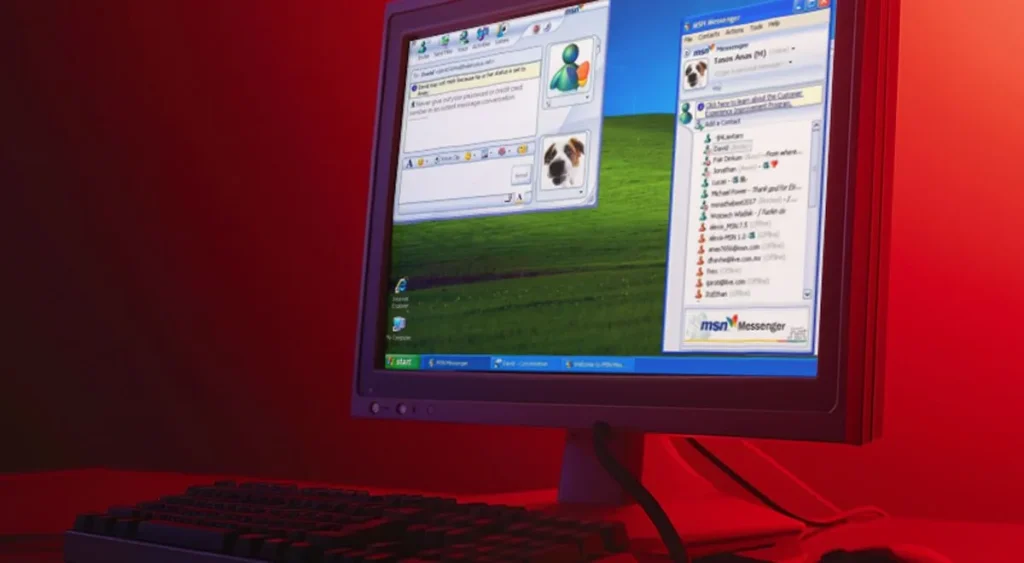
Before WhatsApp, nobody reached their friends by smoke signal. For a decade, millions of people spent their afternoons parked in front of a program with a little figure spinning in the corner, a knock every time a message landed and a button that shook the whole screen of whoever was on the other end. That program was MSN Messenger.
MSN Messenger didn’t die because you stopped loving it. It died because the ground moved under its feet. You went from a keyboard on a desk to a phone in your pocket, and a messenger welded into Windows stopped making sense. This is the story of how the most open window on the desktop finally closed.
What MSN Messenger was, and how it started
MSN Messenger shipped on 22 July 1999, a few months before the world panicked about Y2K. Microsoft announced it on 21 July and put it up for download at midnight. The whole installer weighed 320 KB. Read that again: 320 kilobytes. It fit on a floppy disk and came down a 28.8 kbps modem in about three minutes. It was Microsoft’s answer to AIM, AOL’s messenger, which owned the room back then.
You may have forgotten what the letters stood for. MSN was the Microsoft Network, the company’s first big bet on the consumer internet. The masterstroke with the messenger came down to distribution. Microsoft already ran the most widely used operating system in the world and owned Hotmail, so it never had to win you over. It only had to come pre-installed. Windows XP shipped with a messenger in the box, and MSN Messenger used the same username and password as your Hotmail account. That red carpet did the rest. For a lot of people, the first window they opened on the internet was a contact list.
The early versions did more than chat. They flagged new email in your inbox, let you run voice and video conferences through NetMeeting, and promised to talk to other messaging networks. That last promise was more hope than product. Interoperability stayed a talking point for years.
Those early years set the ritual you would repeat for the next decade. You opened the program, heard the door swing open, watched the list fill with names, and waited for a knock. A knock meant somebody wanted you. That one sound carried more weight than any notification that came after it.
The rise: the golden years
For more than a decade, MSN Messenger was the front door to the internet for a generation. A handful of small details made it impossible to forget:
- The nudge. One button and the other person’s screen jumped off the desk. It was a joke between friends, or a declaration of war.
- The emoticons. Long before emoji, a typed face already carried a whole tone of voice.
- The personal status. Song lyrics, quotes and coded lines, chosen for one specific person on your list to decode.
- File transfer. This is how songs, photos and homework actually moved from one house to another.
- Video calls. For plenty of users, the first time they ever saw themselves on a screen.
The muscle behind it all was the network. Every new user dragged in their friends, and every friend arrived with a contact list of their own. That is why the competition’s head start did not matter. AIM had the longer history. ICQ had invented the «uh-oh» that announced a message. Yahoo Messenger had its own chat rooms. None of it counted, because the fight happened on the desktop where everything else already lived.
In 2005 Microsoft rebranded the product as Windows Live Messenger, part of the Windows Live wave. It kept the essentials: your contacts, your status and your nudges. That rebrand bought a few more years while instant messaging stopped being a nerdy habit and turned into the normal way to make plans.
The peak came in 2009: around 330 million monthly active users worldwide, the number Microsoft was quoting at the time. It was at its strongest right as the clouds were gathering.
The rivals: from AIM to WhatsApp
MSN Messenger lost three fights in a row, wave by wave. The first wave was the desktop messengers, AIM, ICQ and Yahoo Messenger, each with its own tribe. Microsoft won that round on distribution.
The second wave arrived when chat moved onto the web. Google Talk arrived in 2005, bolted onto Gmail. Facebook Chat arrived in 2008 and needed no download at all. All at once you did not have to install anything to talk to someone, and your contact list turned into a tab.
The third wave is the one that finished the job. WhatsApp arrived in 2009, right at Messenger’s peak, and offered a different deal. It was built by two engineers who had worked at Yahoo, and it asked for nothing more than a phone number. You did not log on and wait for the other person to be «online». The message travelled in the phone in your pocket and arrived when it arrived. Messaging became something you carried around.
Why MSN Messenger shut down
The fall was quick, and two causes stacked on top of each other.
- The smartphone. The desktop messenger lost its point the moment the phone became the center of everything. On those small screens WhatsApp grew, doing the same job from a device that was always within reach.
- Social media. Facebook and the rest swallowed the free time and added chat of their own. The desktop stopped being the only room where people gathered.
Then came a decision made in a boardroom. In May 2011 Microsoft bought Skype for $8.5 billion and suddenly owned two messengers competing for the same users. Keeping both made no sense. It had to pick one, and it picked the one that already did voice and video.
On 6 November 2012 came the official announcement. Messenger would be retired, and its users would move to Skype. The migration rolled out language by language through 2013 and was done that year for most of the world. China was the one exception. There the service held on until 31 October 2014, the date a lot of people still remember as the day it closed.
What became of MSN Messenger
There is an irony in the ending that nobody saw coming. Skype was another stop on the same road. Microsoft kept it alive for years, then retired it too on 5 May 2025 and pushed its users towards Microsoft Teams. The chain reads like this: MSN Messenger fed Skype, and Skype ended up inside Teams.
No official service survives. When the servers behind the Chinese service finally went dark, the last official client could no longer reach anyone. Community projects have rebuilt the old protocol so legacy clients can talk to each other again, and one of them, Escargot, has kept the door open for people who still want that contact list on their screen. Treat those as nostalgia projects rather than a Microsoft product. The little figure no longer spins. We remember it spinning.
MSN Messenger vs WhatsApp: what changed
| MSN Messenger | ||
|---|---|---|
| Where it lived | The computer | The phone |
| Presence | «Online» or «away», visible | No status: always available |
| Conversation | Sessions: you logged on and chatted | A continuous stream, without opening anything |
| Access | A Hotmail account | A phone number |
| What it offers | The conversation itself | Utility: groups, calls, payments |
The real difference is presence. On MSN Messenger, being online was a state, and it was public. If you set yourself «away», people noticed, and some of them drew their own conclusions. WhatsApp made that state disappear, and the whole dance around it went with it. Logging on, saying hello and saying goodbye all belonged to that state. Today nobody enters a conversation. The conversation never stops.
Frequently asked questions
What happened to MSN Messenger?
Microsoft replaced it with Skype. It bought Skype in 2011, announced Messenger’s retirement in November 2012 and completed the migration in 2013. In China it survived until October 2014.
In what year did MSN Messenger shut down?
For most of the world it stopped working in 2013, after the migration to Skype. In China it lasted until 31 October 2014, the date many people remember as the definitive closure.
Why was MSN Messenger so successful?
Because it came with Windows and used the same account as Hotmail, so nobody had to be persuaded to use it. Add its pioneering features: nudges, emoticons, statuses and video calls.
Can you use MSN Messenger today?
Not the original service. Community projects have revived the protocol, but none of them is the official Messenger. And its successor, Skype, closed in 2025 as well.
The bottom line
The rise and fall of MSN Messenger is the story of the internet in miniature. A product that ruled the world within a few short years, wired into every desktop, gone the moment the centre of gravity moved from the desk to the pocket.
What it left behind is a way of remembering the network, from a time when going online was an act with its own moment, its own sound and its own goodbye.
If you want to understand why the phone beat everything else, start with how the telephone became the smartphone. For the wider picture, follow the history of computing.