
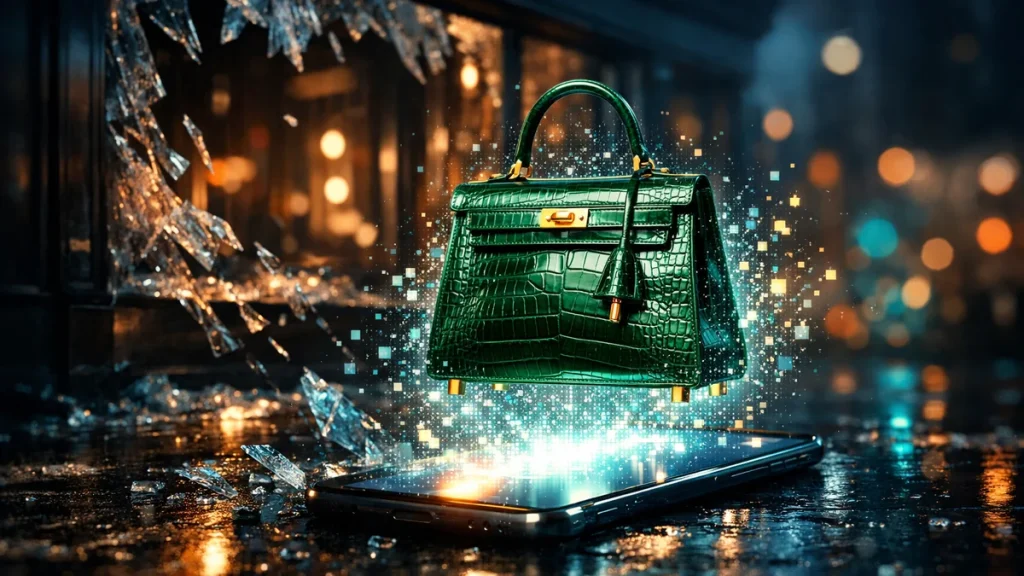
The looting of luxury boutiques in France leaves behind a paradox: you can smash the symbol of wealth and still want it. Technology makes sure we never stop seeing it.
On Saturday 17 October in Paris, some people solved their problem of access to luxury the traditional way: breaking the shop window.
Céline and Kenzo were looted during the disturbances, alongside supermarkets and businesses that had little to do with ostentation, among them family shops whose owners also pay rent, taxes and wages. Le Monde described a scene worth more than any damage report: a young man was looking for a Chanel shop while someone offered Burberry scarves over Signal and told people where to collect them.
Social anger, luxury goods and a messaging app doing the work of a trading floor. All very twenty-first century.
We do not know whether that young man wanted a bag or the money from reselling it. Nor should we confuse those protesting about the cost of living with those who used the disorder to steal. The irony is hard to dodge: on a day of protest against inequality, some people knew exactly which symbols of wealth were worth taking.
Those panes were smashed by hand. Yet each one pointed at other shop windows, the ones we open on our phones daily.
Once you had to travel to certain neighbourhoods to see how the rich lived. Now we have breakfast watching a millionaire’s wardrobe, lunch opposite a Dubai influencer’s villa, and go to bed after a virtual tour of a yacht, without ever meeting their owners.
Technology has made it so we can all look at what almost no one can afford. And the brands are delighted, because the public now distributes their products for free.
I have spent enough years in marketing to know that desire is studied, built and fed. The extraordinary thing about social media is that it has turned us into part of that machinery. We recognise bags by their silhouette and follow the launches of brands that do not even need us as customers.
A study published online in 2025 and collected in the 2026 volume of the Asia Pacific Journal of Marketing and Logistics, with three studies in Portugal, found a link between social media, expectations of recognition and conspicuous consumption. It illustrates how far we use objects to tell other people who we are, now with a much larger audience, even if it does not prove that Instagram forces anyone to buy.
Algorithms do not need to know how much money we have. It is enough to watch what we look at and how long we linger. Someone who cannot make ends meet can spend the afternoon looking at houses they will never buy, restaurants they will never eat in and watches that cost more than their car.
We used to compare ourselves with neighbours, colleagues and one especially lucky brother-in-law. Now we compare ourselves with the whole planet, and the planet, conveniently edited, lives far better than we do.
On the internet we see the photograph and the smile. The bills stay out of the frame.
I can admire a five-thousand-euro coat for its wool, its cut and its colour, without believing my life will improve if I buy it. What unsettles me is the ease with which an aesthetic preference hardens into a permanent aspiration.
And yet buyers are beginning to set limits. Bain and Altagamma spotted it back in 2025, a retreat in aspirational consumption. This week LVMH reported an organic decline of 5 % in fashion and leather goods in the third quarter of 2026. It is not the end of luxury, but desire cannot raise prices indefinitely.
Luxury is craftsmanship, materials and design. It is also an enormous amount of symbolic construction. When the price rises faster than the perceived value, the crack appears.
The crack has nothing to do with the shop windows of Paris. It sits elsewhere, and it mends far worse.
Meanwhile technology keeps rewriting the rules. According to the Bain-Altagamma report of June 2026, roughly half of the luxury consumers surveyed already use artificial intelligence while shopping, and a similar share checks the second-hand market before buying new. Brands that once controlled every last detail of their boutiques now compete to appear in automated recommendations.
AI helps compare prices, find alternatives and track down used bags. It can also learn our preferences and recommend the next one. We have built tools that analyse thousands of products in seconds, and it would be a shame to use them only to decide which object announces that we have made it.
Back to Paris. Smashing a shop window lets you take hold of an object that was out of reach, and it changes none of the reasons it was out of reach. Stealing an expensive bag to resell it is a criminal business that only works while people continue to want that brand.
That is the paradox. Prestige survives broken glass.
The same technology that shows the bag to millions of people then lets them advertise where to pick it up. Desire and resale move through the same screens, even though the transactions look nothing alike.
Perhaps the real luxury is having enough time, privacy and independence to feel no need to prove anything. I doubt it will ever be sold in a boutique, though someone will surely find a way.
Meanwhile the shop windows in Paris will be replaced. The digital ones will stay lit. And tonight someone will shake their head at the looting before lingering over a five-thousand-euro bag that their algorithm just recommended.
Without breaking a single pane of glass.